Mind

4-7-8 breathing: what it is, how to do it, and does it help you sleep?

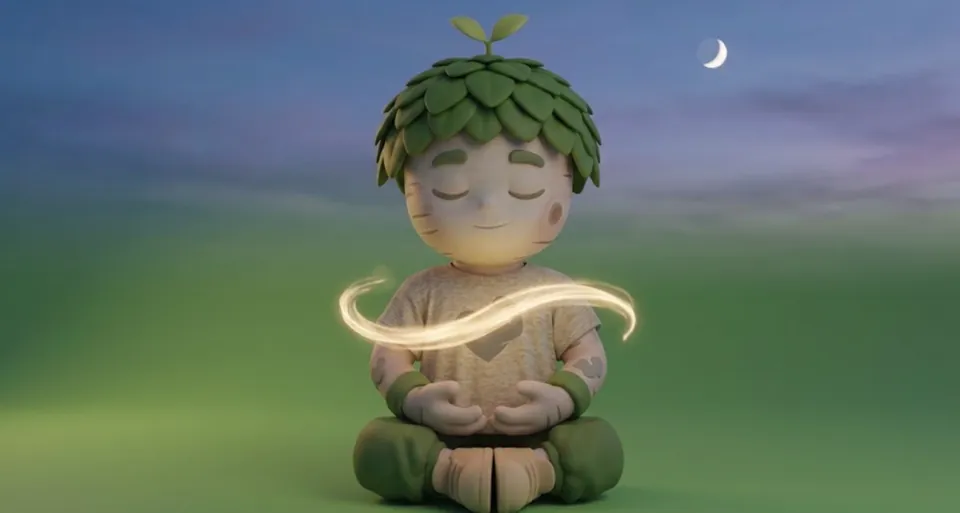
Crew sceneTwig sitting cross-legged at dusk, calm breathing, soft glowing swirl, moon overhead
In for four, hold for seven, out for eight.
In one line

4-7-8 breathing is a slow pattern (in for four, hold for seven, out for eight) that's popular as a way to wind down, but the research on it is small and mixed, so it's best treated as a calming habit rather than a sleep cure.

Twig

Twig here.

Four. Seven. Eight.

Emby asked why not "8-8-8, for maximum gains". We sat him down. He's calmer now.

Where it comes from

4-7-8 breathing is credited to Andrew Weil, an American doctor known for integrative medicine, who popularised it [2]. Researchers describe it as based on pranayama, an ancient family of yogic breathing practices, and say it aims to reduce anxiety and make it easier to fall asleep [1].

How it's done

The pattern is simple to describe:

  1. Breathe out fully through your mouth.
  2. Close your lips and breathe in quietly through your nose for a count of 4.
  3. Hold your breath for a count of 7.
  4. Breathe out through your mouth, with a soft "whoosh", for a count of 8.

That's one round. In one study, researchers had participants lie down with their eyes lightly closed in a quiet room and repeat the cycle several times [1]. The same researchers calculated that the pattern works out at roughly three breaths a minute, which is very slow [1].

The out-breath is twice as long as the in-breath. That long exhale is the heart of the technique.

Bar chart

Breaths a minute by pattern

Breaths a minute by pattern
Labela minute
Box (4-4-4-4)3.75
4-7-83.2
Six a minute6
Source: patterns worked out from each pattern's counts; comparison from Marchant et al. 2025 [3].
Try it now

Try one round now

Ready when you are

0 done this round

Feel light-headed? Stop and breathe normally.

Full tool with sounds →

Our 4-7-8 breathing tool counts it for you, with a gentle on-screen guide, so all you have to do is follow. Try 4-7-8 breathing →

What the research says

Here's the honest part. 4-7-8 breathing is everywhere online, but it hasn't been studied much.

One small study found calming changes in the body. In a 2022 study of 43 healthy young adults, a short session of 4-7-8 breathing lowered heart rate and systolic blood pressure and changed heart rate variability, whether or not people had slept badly the night before [1]. It was a single session in a small group, so it tells us what happens in the moment, not over weeks.

Another found it no better than other slow patterns. A 2025 study of 84 college students compared box breathing, 4-7-8 breathing and breathing at six breaths a minute [3]. The authors pointed out that, for all their popularity, box and 4-7-8 breathing have "little empirical support" [3]. Six breaths a minute raised heart rate variability more than 4-7-8, and none of the patterns made a meaningful difference to mood or blood pressure in that single session [3].

A third found mixed results. A 2026 crossover study had 34 university students try 4-7-8 breathing, an alternate-nostril practice and ordinary resting breathing, 10 minutes each [4]. 4-7-8 breathing was linked with lower stress and negative feelings in women, while the alternate-nostril practice did more for men. Neither made a significant difference to standard heart rate variability measures [4].

Long out-breaths in general. A 2023 Stanford trial of daily five-minute breathing practices found that an exhale-focused pattern called cyclic sighing improved mood more than mindfulness meditation over a month [6]. That wasn't 4-7-8, but it's another sign that breathing patterns built around a long out-breath are worth studying.
Does it help you sleep?

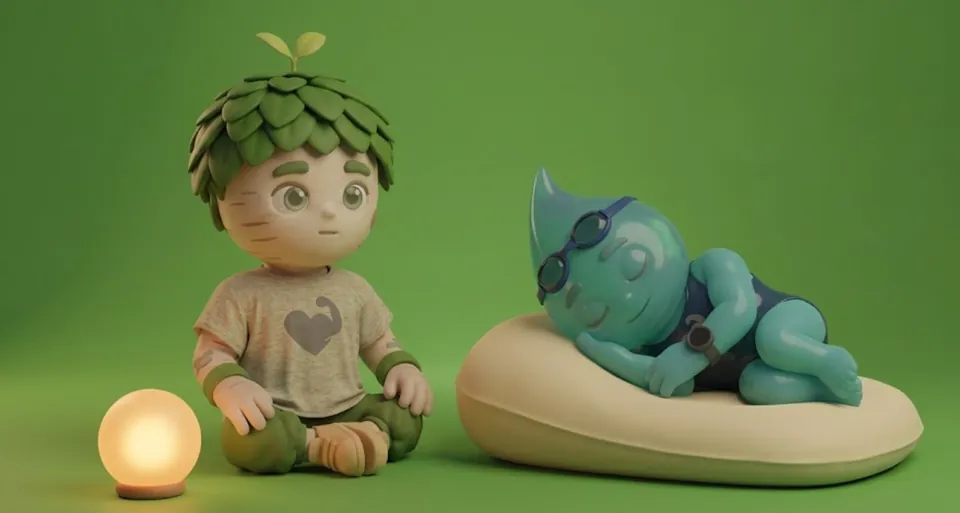
Crew sceneTwig and Dewy doing a calm bedtime breathing practice together in a cosy nook
Guest cameo

Dewy: Is this going to make me fall asleep instantly?

Twig: No good trial says that yet — but it's a calming habit, and habits help.

There isn't a good trial of 4-7-8 breathing and sleep yet.

The closest evidence is about slow breathing in general. In a small 2015 study, 14 people with self-reported insomnia practised slow, paced breathing for 20 minutes before bed. On those nights they took less time to fall asleep, woke up less, and slept more efficiently, measured in a sleep lab [5]. That was a different, simpler pattern, done for longer.

The NHS lists relaxing before bed among its self-help steps for poor sleep [7]. A few slow rounds of breathing is one way to make that part of your evening. Just don't expect it to work every night.

The easier version

The easier version

The seven-count hold is a lot. If it feels strained, shrink the numbers but keep the shape.

  • Gentle version: in for 4, hold for 4, out for 6.
  • Even gentler: in for 4, out for 6, no hold at all.

Keep the out-breath longer than the in-breath. That's the bit that matters most to this pattern.

If you feel dizzy or light-headed, stop and breathe normally. It's not a contest.

Small steps still count.

When calm isn't enough

Support

Breathing exercises help with calm. They aren't a substitute for support. If sleep problems go on for months or are affecting your daily life, the NHS suggests seeing a GP [7].

If things feel heavy, you don't have to carry it alone:

  • Samaritans: call 116 123, free, from any phone, day or night [8]. samaritans.org
  • Mind: information and support at mind.org.uk
  • Beat, the UK eating disorder charity: beateatingdisorders.org.uk
  • NHS: for urgent help with your mental health, contact NHS 111 or ask for an urgent GP appointment. If someone's life is at risk, or you don't feel you can keep yourself safe, call 999 or go to A&E [9].
Twig standing with one hand on their chest, mid slow exhale
Free tool

4-7-8 breathing

In for 4, hold for 7, out for 8. Four slow rounds — the long out-breath is the point.

Try it →
FAQ

Does 4-7-8 breathing really help you fall asleep? It hasn't been properly tested for sleep yet. Slow, paced breathing before bed did help people with insomnia fall asleep faster in one small study [5], and 4-7-8 is a type of slow breathing [1], but the evidence for this exact pattern is thin [3].

How many rounds should I do? Studies have used a few rounds up to about 10 minutes of practice [1][4]. The kind.fit tool keeps it to four rounds, which is short enough to actually happen at bedtime.

Is it safe? The studies above were in healthy young adults [1][3][4], so they say little about anyone else. Holding your breath doesn't suit everyone: if you feel dizzy, stop, and if you have a heart or lung condition, a GP can tell you whether breath holds are right for you. The gentler versions keep the long out-breath without the hold.

Breathe first. Then sleep. Then, tomorrow, maybe roots.

How we check

Checked against 9 sources · Updated 29 September 2026 · Expert review: not yet

kind.fit shares information, not medical advice. If something doesn't feel right, talk to your GP or call NHS 111.

Sources
  1. Vierra J, Boonla O, Prasertsri P. "Effects of sleep deprivation and 4-7-8 breathing control on heart rate variability, blood pressure, blood glucose, and endothelial function in healthy young adults." Physiological Reports, 2022;10(13):e15389. https://pmc.ncbi.nlm.nih.gov/articles/PMC9277512/ (accessed 29 September 2026)
  2. Wikipedia contributors. "Andrew Weil." Wikipedia. https://en.wikipedia.org/wiki/Andrew_Weil (accessed 29 September 2026)
  3. Marchant J, Khazan I, Cressman M, Steffen P. "Comparing the Effects of Square, 4-7-8, and 6 Breaths-per-Minute Breathing Conditions on Heart Rate Variability, CO2 Levels, and Mood." Applied Psychophysiology and Biofeedback, 2025;50(2):261–276. https://pubmed.ncbi.nlm.nih.gov/39864026/ (accessed 29 September 2026)
  4. Avcık FE, Koç F, Aktop A. "Acute Psychophysiological Effects Of 4-7-8 And Nadi Shodhana Breathing: A Randomized Crossover Study." Applied Psychophysiology and Biofeedback, 2026 (online ahead of print). https://pubmed.ncbi.nlm.nih.gov/42771122/ (accessed 29 September 2026)
  5. Tsai HJ, Kuo TB, Lee GS, Yang CC. "Efficacy of paced breathing for insomnia: enhances vagal activity and improves sleep quality." Psychophysiology, 2015;52(3):388–396. https://pubmed.ncbi.nlm.nih.gov/25234581/ (accessed 29 September 2026)
  6. Balban MY, et al. "Brief structured respiration practices enhance mood and reduce physiological arousal." Cell Reports Medicine, 2023;4(1):100895. https://pubmed.ncbi.nlm.nih.gov/36630953/ (accessed 29 September 2026)
  7. NHS. "Insomnia." https://www.nhs.uk/conditions/insomnia/ (accessed 29 September 2026)
  8. Samaritans. "Contact a Samaritan." https://www.samaritans.org/how-we-can-help/contact-samaritan/ (accessed 29 September 2026)
  9. NHS. "Where to get urgent help for mental health." https://www.nhs.uk/nhs-services/mental-health-services/where-to-get-urgent-help-for-mental-health/ (accessed 29 September 2026)
The kind.fit letter

One kind email a week. You pick the topics — sign-up is coming soon.

Tick a topic to say what you want to hear about first.