
Recovery
How long should you rest between sets?

For people new to lifting, research suggests one to two minutes between sets is plenty for building strength, and the exact number on the clock matters less than most gym arguments suggest.

Hi, Dewy here. Recovery is training too, and that includes the little recoveries in the middle of a workout. Emby's idea of resting between sets is doing a different set. Gust's is jogging on the spot while checking the timer. Twig's is… well, Twig is still resting from last Tuesday.
So who's right? Let's look at what the research says.
What rest between sets is for
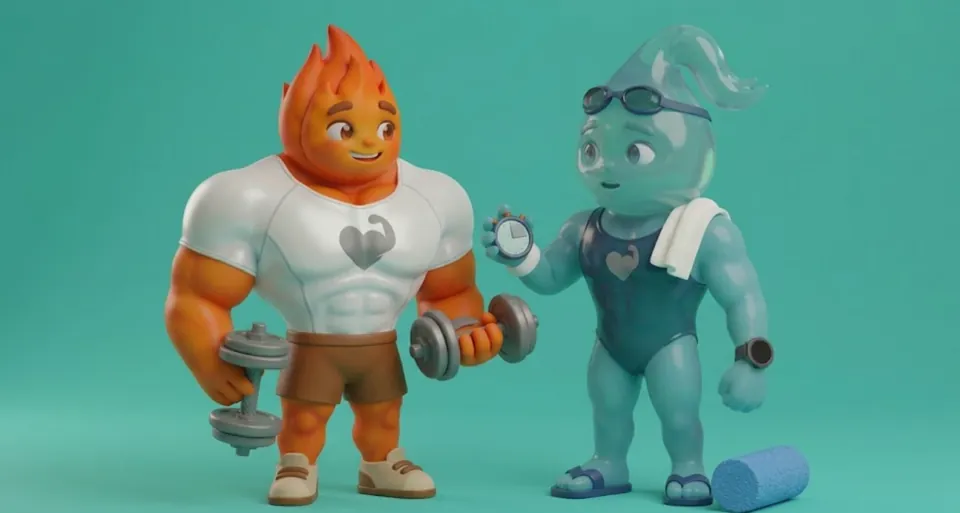
Emby: Rest is just doing a different set, right?
Dewy: No. Rest is resting. One to two minutes is plenty for a beginner — the research says so.
After a hard set, how well the next set goes depends partly on how long you rest [3]. Rest length is one of the classic dials in a strength programme, along with weight, reps and sets [3].
A 2009 review of 35 studies found that, when lifting moderate to heavy weights, resting 3 to 5 minutes let people do more reps across several sets than shorter rests did [3]. More reps over a session means more total work, which is the main reason longer rests have been linked with bigger strength gains in some studies [3].
What the research says for beginners
Here's the good news for anyone new. A 2018 systematic review looked at 23 studies on rest length and long-term strength gains [1]. Its conclusions [1]:
- Solid strength gains happened even with short rests of under 60 seconds.
- For people who were already trained, longer rests of over 2 minutes seemed to be needed to get the most strength.
- For untrained people, short to moderate rests of 60 to 120 seconds seemed to be enough to get the most out of strength training.
That last point is the one that matters if you're just starting. One to two minutes covers it.
| Group | Rest that seemed enough |
|---|---|
| New to lifting | 60 to 120 seconds for strength |
| Already trained | Over 2 minutes for strength |
| Building muscle | A small edge past 60 seconds; little extra past ~90 |
How long do you usually rest between sets?
Your own answer, saved on this device only — not a survey of the UK.
The newest big summary agrees that rest length isn't something to stress over. The American College of Sports Medicine's 2026 position stand found that strength gains were not affected by shorter (under 1 minute) versus longer (over 1 minute) rests between sets in the research it reviewed [5].
What about building muscle?
Muscle size (hypertrophy) is a slightly different question. A 2024 meta-analysis pooled nine randomised studies on rest length and muscle growth [2]. The results overlapped a lot between short and longer rests, with a lot of variation between studies. The authors concluded there may be a small benefit to resting more than 60 seconds, possibly because longer rests let people keep doing more total work. Beyond about 90 seconds, they didn't find any clear extra difference [2].
One widely cited 2016 study of trained young men compared 1-minute and 3-minute rests over eight weeks. The 3-minute group gained more strength in the squat and bench press, and more muscle thickness in the front of the thigh [4]. That study was in experienced lifters, not beginners, which fits with the 2018 review's view that trained people benefit more from longer rests [1][4].
So why do the numbers differ?
You'll see very different rest advice online. Part of that comes from older guidelines. The 2009 ACSM position stand suggested 3 to 5 minutes between heavy sets for intermediate and advanced lifters, and 1 to 2 minutes for muscle-building work at moderate weights [6]. The longer figure was never aimed at people on their first programme.
The 2009 review also noted that short rests of 30 to 60 seconds had been suggested for muscle building [3]. Later research on long-term muscle growth, like the 2024 meta-analysis, found little difference between rest lengths and a possible small edge for rests over 60 seconds [2]. Science moves on, and that's a good thing.
The kind summary: for a beginner, pretty much any sensible rest works. The part that matters most is showing up and doing the sets.
A rest timer makes it easy
The hardest part of resting is actually doing it, not chatting, scrolling, or wandering off to find another dumbbell. Our rest timer counts down your chosen rest with a halfway mark and a 3-2-1 before you go again. Set it once and forget the maths. Try the rest timer →
The easier version
Timing things feels like one job too many? Here's the no-clock version:
- Rest until your breathing has settled and you feel ready to do the next set with good form.
- If that takes longer than about two minutes, that's fine. Longer rests are linked with more reps per session, not less progress [3].
- If you're short on time, shorter rests still gave solid strength gains in the research [1]. You can also pair exercises, like doing a set of rows while your legs rest from squats.
The rest research above mostly compared straight sets of one exercise, so pairing is a practical time-saver rather than something those studies tested.
A kind word on pushing through
Rest is not weakness. If you ever feel dizzy, sick, or unusually out of breath between sets, stop the session. That's your body asking for more than a timer can give, and if it keeps happening, a GP is the right person to talk to.

Rest timer
Time the rest between sets, so "one more set" actually happens.
Try it →Is 30 seconds of rest enough? Solid strength gains have been seen with rests under 60 seconds [1]. For building muscle, a 2024 meta-analysis suggested a small benefit to resting longer than 60 seconds [2], so very short rests may be a trade-off rather than a mistake.
Do I need to rest longer as I get stronger? Possibly. The 2018 review found that trained lifters seemed to need rests over 2 minutes to get the most strength, while untrained people did well with 60 to 120 seconds [1].
Is it bad to rest too long? The research doesn't show long rests harming strength gains; the 2009 review linked 3 to 5 minutes with more reps and bigger strength gains when lifting heavy [3]. The main cost of long rests is time.
Now go and rest properly. That means sitting down, Emby. Sitting. Down.
Checked against 6 sources · Updated 29 September 2026 · Expert review: not yet
kind.fit shares information, not medical advice. If something doesn't feel right, talk to your GP or call NHS 111.
- Grgic J, Schoenfeld BJ, Skrepnik M, Davies TB, Mikulic P. "Effects of Rest Interval Duration in Resistance Training on Measures of Muscular Strength: A Systematic Review." Sports Medicine, 2018;48(1):137–151. https://pubmed.ncbi.nlm.nih.gov/28933024/ (accessed 29 September 2026)
- Singer A, et al. "Give it a rest: a systematic review with Bayesian meta-analysis on the effect of inter-set rest interval duration on muscle hypertrophy." Frontiers in Sports and Active Living, 2024;6:1429789. https://pubmed.ncbi.nlm.nih.gov/39205815/ (accessed 29 September 2026)
- de Salles BF, et al. "Rest interval between sets in strength training." Sports Medicine, 2009;39(9):765–777. https://pubmed.ncbi.nlm.nih.gov/19691365/ (accessed 29 September 2026)
- Schoenfeld BJ, et al. "Longer Interset Rest Periods Enhance Muscle Strength and Hypertrophy in Resistance-Trained Men." Journal of Strength and Conditioning Research, 2016;30(7):1805–1812. https://pubmed.ncbi.nlm.nih.gov/26605807/ (accessed 29 September 2026)
- Currier BS, et al. "American College of Sports Medicine Position Stand. Resistance Training Prescription for Muscle Function, Hypertrophy, and Physical Performance in Healthy Adults: An Overview of Reviews." Medicine & Science in Sports & Exercise, 2026. https://pmc.ncbi.nlm.nih.gov/articles/PMC12965823/ (accessed 29 September 2026)
- American College of Sports Medicine. "Progression models in resistance training for healthy adults." Medicine & Science in Sports & Exercise, 2009;41(3):687–708. https://pubmed.ncbi.nlm.nih.gov/19204579/ (accessed 29 September 2026)