
Strength
How often should a beginner do strength training?
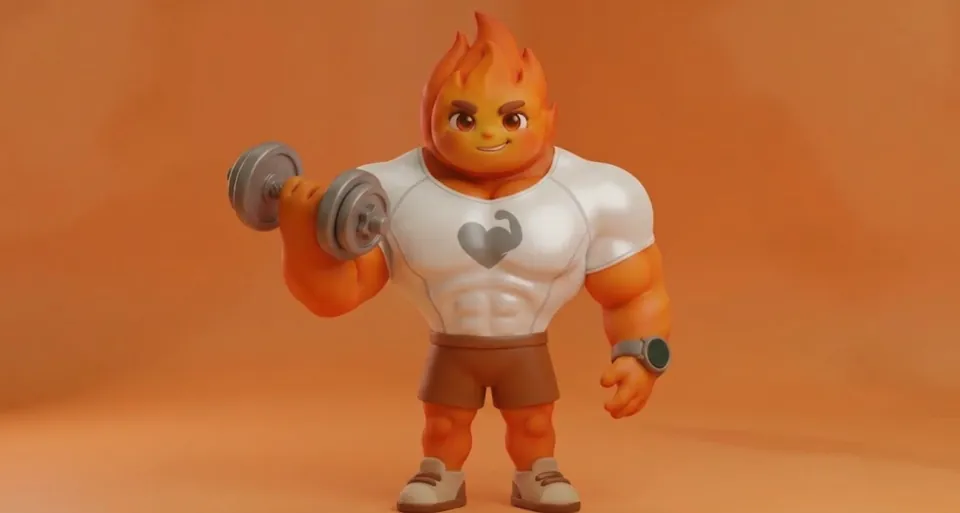
The UK guidelines say at least two days a week, covering every major muscle group, and the research is clear that a little done regularly beats a lot done once.
Emby here! Let's gooo! Okay, confession first: my honest answer to "how often?" used to be "every day, twice, plus one more set". The crew had a word with me. So this time the answer comes from the people who actually write the guidelines, and it's a lot friendlier than mine was.
What the guidelines actually say
The NHS and the UK Chief Medical Officers both set the same bar for adults: strengthening activities on at least two days a week [1][2]. The NHS spells out what "all the major muscle groups" means: legs, hips, back, abdomen, chest, shoulders and arms [1].
The Chief Medical Officers add a line worth sticking on the fridge: muscle strengthening on at least two days a week, "but any strengthening activity is better than none" [2]. Two days is the target. One day is still a win. Zero days is just where you're starting from.
The World Health Organization makes the same point more broadly. Around 31% of adults worldwide don't reach the recommended activity levels, and WHO notes that muscle strengthening benefits everyone [3]. It also lists what regular activity is linked with in adults: a lower risk of early death, heart disease, high blood pressure, type 2 diabetes, some cancers and falls, plus better mental health, thinking and sleep [3].
So why do so few people lift? A 2026 position stand from the American College of Sports Medicine (ACSM) estimates, from self-reported data, that only about 30% of American adults do some muscle strengthening on two or more days a week, and nearly 60% do none at all [4]. If you're not lifting yet, you're in the biggest club there is. Welcome. We have snacks. (Dewy made me say that.)
Two days a week, in practice

Dewy: Two days sounds manageable — promise you'll actually rest on the other five?
Emby: Right?! And one set already counts — the research says so [4].
How many strength days fit your week right now?
Your own answer, saved on this device only — not a survey of the UK.
"Two days a week, all the major muscles" sounds like a lot until you see how little it takes to tick it off.
The ACSM's 2026 review pulled together the research on how to set up a strength programme. A few findings matter a lot when you're new [4]:
- One set counts. In the review's words, "one set is superior to zero sets", and two sets beat one [4]. Your first session doesn't need to be long to be worth it.
- You don't need to go to failure. Taking every set until you physically can't do another rep did not add extra strength, muscle or power in the research it reviewed [4]. Stopping with a rep or two left in the tank is fine.
- Machines and free weights both work. Strength gains were not affected by choosing machines over free weights, or the other way round [4]. Use whatever you have, or whatever feels least intimidating.
- Rest between sets matters less than people think. Short and long rest between sets did not change strength outcomes in the evidence it reviewed [4].
- Frequency matters less once the total work is the same. Training more often did help strength, but that effect shrank when the total amount of work per week was matched [4]. Two good sessions can do the job.
The older 2009 ACSM position stand, which many gym programmes are still built on, suggested two to three days a week for people new to lifting [5]. The newer review is less rigid: it argues that getting people to lift at all matters more than hitting precise numbers, and it notes that "minimal doses" of resistance training can bring substantial gains in strength and function [4].
A common beginner pattern that fits all of this: two sessions a week with a day or more between them (say Monday and Thursday), each one covering legs, a push, a pull and something for the middle. That's a structure, not a prescription. Your week, your call.
Does it have to be a gym?
Nope! The ACSM defines resistance training as working your muscles against resistance, which can mean free weights, machines, resistance bands, water or your own body weight [4]. The NHS has a whole set of strength exercises designed to be done at home with a sturdy chair and a wall [6].
If your "gym" is the living-room floor for now, that still counts. Bodyweight squats to a chair, press-ups against a wall, a backpack full of books for rows. Same muscles, same guideline.
How do you know it's working?
Progress when you're new tends to show up as "that felt easier than last week". The NHS strength routine suggests building up slowly and gradually adding repetitions over time [6], which is a simple way to see change without any maths.
If you like numbers, our strength standards tool shows where a lift sits against your body weight, from Beginner to Elite, and exactly what the next level looks like. Beginner is where every lifter starts, including every champion you've ever heard of. It's a signpost, never a score. Try the strength standards tool →
The easier version
Two days a week feels like too much right now? Here's the gentle on-ramp:
Two days a week, in practice
- **One day a week, 15 minutes.** A set of each: sit-to-stand from a chair, wall press-ups, and a row with a backpack or band.
- **Stop every set with two or three reps still in you.** The research above says going to failure isn't needed [4].
- **After a few weeks, add a second short day.** That's the guideline ticked off [1][2].
That first 15-minute day already moves you from "none" to "some". The Chief Medical Officers point out that health gains from activity are especially large for people who are currently doing the least [2]. Small, boring, repeated: that's the whole trick. (I hate that it works. It works.)
A kind word on pain
Muscles feeling worked is normal. Sharp pain, joint pain, or pain that doesn't settle is not something to push through. Stop, and talk to a GP or physiotherapist if it keeps happening. I've learned this one the hard way so you don't have to.
Strength standards
See where your squat, bench, deadlift or press sits, from Beginner to Elite.
Try it →Is two days a week really enough for a beginner? It meets the UK guideline for muscle strengthening [1][2], and the research reviewed by the ACSM found that minimal doses of resistance training still produced substantial gains [4].
Should I lift the same muscles two days in a row? The guidelines don't set a rule on this [1][2]. Plenty of beginner plans simply space sessions out with a rest day between, which also makes it easier to fit into a normal week.
Do I need heavy weights to count? No. The guidelines count any activity that works the major muscle groups [1], and the ACSM includes bodyweight, bands and water as resistance [4]. Heavier loads are one way to build strength over time, not an entry requirement.
One more set! …No. Okay. Rest day. Fine.
Checked against 6 sources · Updated 29 September 2026 · Expert review: not yet
kind.fit shares information, not medical advice. If something doesn't feel right, talk to your GP or call NHS 111.
- NHS. "Physical activity guidelines for adults aged 19 to 64." https://www.nhs.uk/live-well/exercise/physical-activity-guidelines-for-adults-aged-19-to-64/ (accessed 29 September 2026)
- Department of Health and Social Care. "UK Chief Medical Officers' physical activity guidelines." GOV.UK, 2019. https://www.gov.uk/government/publications/physical-activity-guidelines-uk-chief-medical-officers-report/uk-chief-medical-officers-physical-activity-guidelines (accessed 29 September 2026)
- World Health Organization. "Physical activity" fact sheet, 26 June 2024. https://www.who.int/news-room/fact-sheets/detail/physical-activity (accessed 29 September 2026)
- Currier BS, et al. "American College of Sports Medicine Position Stand. Resistance Training Prescription for Muscle Function, Hypertrophy, and Physical Performance in Healthy Adults: An Overview of Reviews." Medicine & Science in Sports & Exercise, 2026. https://pmc.ncbi.nlm.nih.gov/articles/PMC12965823/ (accessed 29 September 2026)
- American College of Sports Medicine. "Progression models in resistance training for healthy adults." Medicine & Science in Sports & Exercise, 2009;41(3):687–708. https://pubmed.ncbi.nlm.nih.gov/19204579/ (accessed 29 September 2026)
- NHS. "Strength exercises." https://www.nhs.uk/live-well/exercise/strength-exercises/ (accessed 29 September 2026)