
Strength
How to warm up before lifting weights
A good lifting warm-up is a few minutes of easy movement followed by lighter sets of the exercise you're about to do, so the heavy work arrives when your body is ready for it.

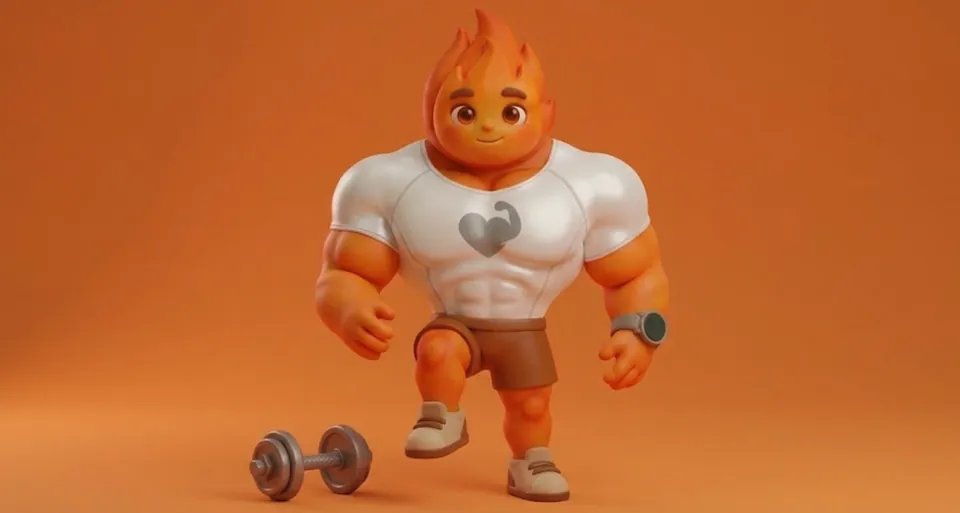
Emby here! I used to think a warm-up was a waste of good lifting time. Walk in, load the bar, go! Then Twig asked me why I always looked stiff on my first set and brilliant on my third. Turns out my first two sets were my warm-up. I was just doing them badly.
So let's do it properly. Short, simple, and backed by research.
What a warm-up actually does
Researchers have been arguing about warm-ups for decades, so here's what the better studies show.
It tends to help performance. A 2010 systematic review and meta-analysis looked at 32 high-quality studies of warm-ups that included more than just stretching. Warming up improved performance in 79% of the measures examined, and the authors found little evidence that it did any harm [2].
It's less clear-cut on injuries. An earlier review of randomised controlled trials found five good-quality studies. Three showed that warming up significantly lowered injury risk and two did not. The authors concluded the evidence wasn't strong enough to say for sure either way, though on balance it leaned towards fewer injuries [3]. The NHS still recommends a proper warm-up to help prevent injury and make exercise more effective [1].
It changes how fast muscles can produce force. A 2025 meta-analysis of 33 studies found that raising muscle temperature improved fast, explosive force (how quickly you can produce force and power) but not maximum force [5]. In plain terms: a warm body moves more crisply. It doesn't magically add kilos to your best lift.
The kind of warm-up mattered less than expected. In that same 2025 analysis, active warm-ups (moving) didn't outperform passive ones (such as a warm environment) in the studies available, though the authors said there wasn't enough data to compare subgroups robustly [5].
The two-part lifting warm-up
Most lifting warm-ups have two parts. Neither needs to be long.

Twig: Have you warmed up, or just walked in and grabbed the heaviest bar?
Emby: …General movement first. Then the bar. I know the rules now.
The two-part lifting warm-up
- **General movement, about 5 minutes:** a bike, a rower, or marching and knee lifts.
- **Ramp-up sets:** empty bar for about 10 easy reps, then a few jumps, fewer reps each time.
Do you warm up before lifting?
Your own answer, saved on this device only — not a survey of the UK.
Part 1: General movement (about 5 minutes)
This is anything that gets you moving and breathing a bit harder. The NHS general warm-up takes at least six minutes: marching on the spot, heel digs, knee lifts, shoulder rolls and knee bends [1]. On a gym floor that could be a few minutes on a bike or rower instead.
A 2011 review of stretching research described a common recommended structure: light aerobic activity first, then large, dynamic movements, then activity specific to the sport [4]. For lifting, the "sport-specific" bit is Part 2.
Part 2: Ramp-up sets of your first lift
This is where you rehearse the exact movement with lighter loads, climbing towards your working weight. A common pattern is:
- The empty bar (or a very light weight) for about 10 easy reps
- Then a few jumps up in weight, doing fewer reps each time
- The last warm-up set is close to your working weight, for just one or two reps
The reps drop as the weight rises so that you arrive at your working sets feeling warm, not tired. Our warm-up set calculator builds this ramp for you: type in today's working weight and it lays out each set, rounded to plates you can actually load. Try the warm-up set calculator →
There's also a strength reason to put your big lift near the start. The 2026 ACSM position stand found that strength gains were greater when exercises were done at the beginning of a session rather than at the end [6]. A tidy warm-up means your first lift is also your freshest.
Where does stretching fit?
This is the bit everyone's confused about, me included.
Long, static stretches (holding a position for a while) right before lifting used to be standard. Then a large number of studies linked them to short-term dips in performance [4]. A 2011 review pulled that research together and found a more nuanced picture: short static stretching, under about 90 seconds in total, and not pushed to the point of discomfort, often showed no harmful effect. Dynamic stretching (moving through a range, like leg swings) either had no effect or improved performance [4].
The same review noted that static stretching done in a separate session still has range-of-motion benefits [4]. The NHS keeps its warm-up to movement and points to a separate routine for stretching after exercise [1].
So a lot of people do moving stretches before lifting and save longer holds for afterwards, or for another time of day. Dewy has a whole stretch builder for that part.
The easier version
Short on time or new to all this? Here's the minimum that still covers the basics:
- Two or three minutes of marching on the spot or easy cycling. You want to feel slightly warmer, not puffed out.
- One set of your first exercise with no weight at all. Bodyweight squat before a goblet squat, a wall press-up before a bench press.
- One set at about half your working weight. Then start.
That's five minutes, and every part of it lines up with the structure described in the research above [1][4]. If a warm-up set ever feels like hard work, it's too heavy: go lighter next time. Warm-ups are rehearsal, not a workout.
A kind word on pain
A warm-up should make you feel looser. If something hurts during a warm-up set, that's information, not a challenge. Skip that exercise today, and if the same spot keeps hurting, a GP or physiotherapist is the right person to ask. (Yes, Dewy, I'm writing it down this time.)

Warm-up set calculator
A ramp from the empty bar to your working weight — warm, not tired.
Try it →How long should a warm-up before lifting take? The NHS general warm-up takes at least six minutes [1], and ramp-up sets of your first lift add a few more. The aim is to arrive warm, not tired, so a warm-up that leaves you out of breath has probably gone past its job.
Is it bad to stretch before lifting? Not necessarily. Research suggests short static stretches (under about 90 seconds in total, at low intensity) usually don't cause problems, and dynamic stretches may help [4]. Long, intense static stretching straight before a heavy lift is the version most linked to a short-term dip in performance [4].
Do I need to warm up for every exercise? A common approach is a full ramp for the first big lift of the day, then just one lighter set to rehearse the movement for later exercises, since the body is already warm by then. The warm-up research mostly studies the start of a session, so this part is gym habit rather than something the studies test [2][5].
Warm up, lift, then… One more set? No? Okay. Rest day tomorrow. Fine.
Checked against 6 sources · Updated 29 September 2026 · Expert review: not yet
kind.fit shares information, not medical advice. If something doesn't feel right, talk to your GP or call NHS 111.
- NHS. "How to warm up before exercising." https://www.nhs.uk/live-well/exercise/how-to-warm-up-before-exercising/ (accessed 29 September 2026)
- Fradkin AJ, Zazryn TR, Smoliga JM. "Effects of warming-up on physical performance: a systematic review with meta-analysis." Journal of Strength and Conditioning Research, 2010;24(1):140–148. https://pubmed.ncbi.nlm.nih.gov/19996770/ (accessed 29 September 2026)
- Fradkin AJ, Gabbe BJ, Cameron PA. "Does warming up prevent injury in sport? The evidence from randomised controlled trials?" Journal of Science and Medicine in Sport, 2006;9(3):214–220. https://pubmed.ncbi.nlm.nih.gov/16679062/ (accessed 29 September 2026)
- Behm DG, Chaouachi A. "A review of the acute effects of static and dynamic stretching on performance." European Journal of Applied Physiology, 2011;111(11):2633–2651. https://pubmed.ncbi.nlm.nih.gov/21373870/ (accessed 29 September 2026)
- Wilson CJ, Nunes JP, Blazevich AJ. "The effect of muscle warm-up on voluntary and evoked force-time parameters: A systematic review and meta-analysis with meta-regression." Journal of Sport and Health Science, 2025;14:101024. https://pubmed.ncbi.nlm.nih.gov/39864808/ (accessed 29 September 2026)
- Currier BS, et al. "American College of Sports Medicine Position Stand. Resistance Training Prescription for Muscle Function, Hypertrophy, and Physical Performance in Healthy Adults: An Overview of Reviews." Medicine & Science in Sports & Exercise, 2026. https://pmc.ncbi.nlm.nih.gov/articles/PMC12965823/ (accessed 29 September 2026)