
Strength
Progressive overload for beginners: how you actually get stronger
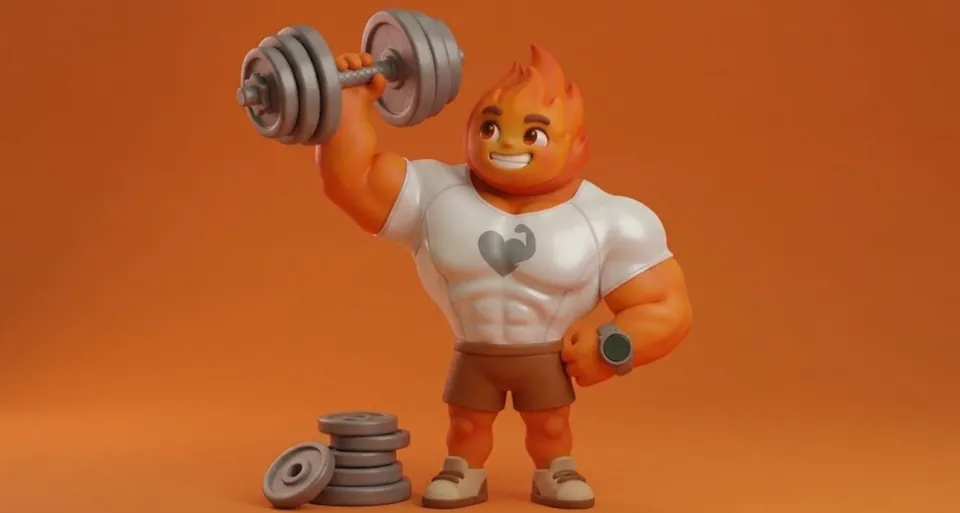
Progressive overload just means gradually asking a bit more of your muscles over time, and for a beginner that can be as simple as one extra rep.
EMBY! Here! With the most exciting two words in lifting! Progressive! Overload! …Okay, Gust says I need to explain it before I shout it. Fair.
What "progressive overload" means
Progressive overload is the idea of nudging the challenge of your training up over time, so your body keeps having something new to adapt to.
The American College of Sports Medicine's 2009 position stand made this a headline principle: to keep adapting towards a goal, resistance training needs to progress [1]. Its updated 2026 position stand adds an important, kinder twist. It says progression is not needed to get beneficial outcomes, and that increasing the challenge in some way is most likely a requirement only for people who want continued progress over the longer term [2].
So there are two honest truths here. Any regular strength training does you good, whether or not the numbers climb [2]. And if you want the numbers to climb, you'll need to slowly do a bit more [1][2].
The ways to "do a bit more"

Dewy: More plates, more plates, more plates.
Emby: Actually — one more rep counts too. So does one more set. Dewy's right, there's more than one way.
When most people hear "overload", they picture piling more plates on the bar. That's one way. It isn't the only one.
Four ways to do a bit more
- **Add reps.** Same weight, one more rep than last time.
- **Add weight.** The classic: a small jump once your reps beat the target.
- **Add sets.** One set counts; two sets counts for more.
- **Improve the rep itself.** A fuller range of motion, done with control.
Add reps
Same weight, one more rep than last time. A 2022 study compared two groups of lifters over eight weeks: one added weight while keeping reps the same, the other added reps while keeping weight the same [3]. Both groups got similar results for strength, muscle size and endurance, with differences the authors described as of questionable practical significance [3].
One caveat: the people in that study already had at least a year of lower-body training [3]. It hasn't been shown in complete beginners in the same way. Still, it's reassuring evidence that "one more rep" is a real form of progress, not a consolation prize.
The NHS home strength routine uses exactly this idea. It suggests building up slowly by gradually increasing the repetitions of each exercise over time [6].
Add weight
The classic. The 2009 ACSM position stand gave a rule of thumb that many programmes still use: when you can do one or two more reps than your target at a given weight, increase the load by around 2 to 10% [1]. For a beginner using light dumbbells, that might be the smallest jump the rack allows.
The 2026 review found that load has repeatedly been shown to affect strength more than other training adaptations [2]. That's why strength programmes usually add weight eventually, even if they start by adding reps.
Add sets
Another option is simply doing more work. The 2026 review put it plainly: one set beats zero sets, and two sets beat one [2]. Going from one set of an exercise to two is a form of progression too.
Improve the rep itself
A fuller range of motion also came out ahead in the 2026 review: training through a complete range of motion improved strength [2]. A squat that goes a little deeper with control, or a press-up that goes a little lower, counts as doing more.
Where your one-rep max comes in
Your one-rep max (1RM) is the heaviest weight you could lift for one clean rep. Many programmes use percentages of it to set working weights, which raises an obvious question for beginners: do you have to find out what it is by lifting as much as possible?
No. You can estimate it from a set you've actually done. A 2006 study had 70 adults aged 18 to 69 perform maximum tests at 1, 5, 10 and 20 reps on the bench press and leg press, then built equations to predict the one-rep max [4]. Predictions from a five-rep set were the most accurate, and the authors concluded that no more than ten reps should be used in simple (linear) prediction equations [4].
Two well-known formulas do this estimate: the Epley formula and the Brzycki formula [5]. They agree closely for lower rep counts but move apart after about ten reps [5], which lines up with the study above.
Our one-rep max calculator uses both formulas and shows their average, plus a chart of what 90%, 80%, 70% and so on look like in real weight. Put in a tidy set you've done and it does the maths. Try the one-rep max calculator →
Directly testing a true one-rep max is considered safe when it's done correctly, but it carries an injury risk for people who aren't yet confident with their form [5]. An estimate gives you most of the planning value without the maximal lift.
The easier version
Numbers, percentages, formulas… too much? Here's progressive overload with no maths at all:
- Pick three exercises and a weight (or no weight) that allows about 8 to 12 comfortable reps. That rep range matches the 2009 ACSM starting suggestion for people new to lifting [1].
- Write down what you did. Exercise, weight, reps. A notes app is fine.
- Next session, try for one more rep on one set. That's it. That's overload.
- When the top of the range feels easy, go up a small step in weight and start back at the bottom. That's the ACSM rule of thumb in everyday language [1].
If a session goes backwards, that's an off day, not a verdict. The trend over a month tells you more than any single session.
A kind word on pain
Progress should feel like effort, never like pain. If an extra rep or an extra kilo makes a joint hurt, that's the moment to drop back, not to grind. Persistent pain is a question for a GP or physiotherapist, not a stronger coffee.
One-rep max calculator
The most you could lift for one clean rep, estimated from a set you actually did.
Try it →How fast should a beginner add weight? The 2009 ACSM guidance was to raise the load by roughly 2 to 10% once you can beat your target reps by one or two [1]. In practice that often means the smallest weight step available. The 2026 review adds that progression isn't required for health benefits at all [2].
Is adding reps as good as adding weight? In one eight-week study of experienced lifters, adding reps and adding weight produced similar gains in strength and muscle size [3]. Load does seem to drive strength more than other factors over time [2], so many programmes combine the two.
Do I need to know my one-rep max? Not to get stronger. It's a planning tool. If you want the number, an estimate from a set of about five reps was the most accurate option in the research [4], with no maximal lift needed.
Progress logged! One more set? …Dewy's giving me the look. Okay. Rest day. Fine.
Checked against 6 sources · Updated 29 September 2026 · Expert review: not yet
kind.fit shares information, not medical advice. If something doesn't feel right, talk to your GP or call NHS 111.
- American College of Sports Medicine. "Progression models in resistance training for healthy adults." Medicine & Science in Sports & Exercise, 2009;41(3):687–708. https://pubmed.ncbi.nlm.nih.gov/19204579/ (accessed 29 September 2026)
- Currier BS, et al. "American College of Sports Medicine Position Stand. Resistance Training Prescription for Muscle Function, Hypertrophy, and Physical Performance in Healthy Adults: An Overview of Reviews." Medicine & Science in Sports & Exercise, 2026. https://pmc.ncbi.nlm.nih.gov/articles/PMC12965823/ (accessed 29 September 2026)
- Plotkin D, et al. "Progressive overload without progressing load? The effects of load or repetition progression on muscular adaptations." PeerJ, 2022;10:e14142. https://pubmed.ncbi.nlm.nih.gov/36199287/ (accessed 29 September 2026)
- Reynolds JM, Gordon TJ, Robergs RA. "Prediction of one repetition maximum strength from multiple repetition maximum testing and anthropometry." Journal of Strength and Conditioning Research, 2006;20(3):584–592. https://pubmed.ncbi.nlm.nih.gov/16937972/ (accessed 29 September 2026)
- Wikipedia contributors. "One-repetition maximum." Wikipedia. https://en.wikipedia.org/wiki/One-repetition_maximum (accessed 29 September 2026)
- NHS. "Strength exercises." https://www.nhs.uk/live-well/exercise/strength-exercises/ (accessed 29 September 2026)