
Recovery
Sore after a workout? What DOMS is and what actually helps
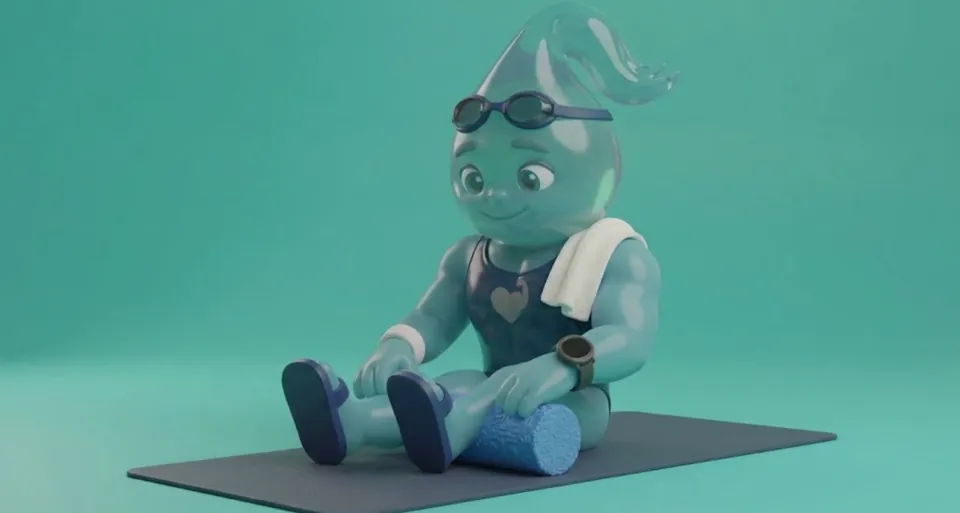
The stiff, achy feeling a day or two after new or harder exercise is called delayed onset muscle soreness (DOMS); it usually peaks within three days, fades within a week, and gets milder the more often you do the same kind of workout.

Hi, it's Dewy. You did a new workout. You felt fine. Then the next morning, getting out of bed felt like an Olympic event and the stairs became your enemy. Welcome to DOMS. Emby calls it "the good hurt". I call it your muscles asking for a gentle day. Let's talk about what's going on, kindly.
What DOMS is
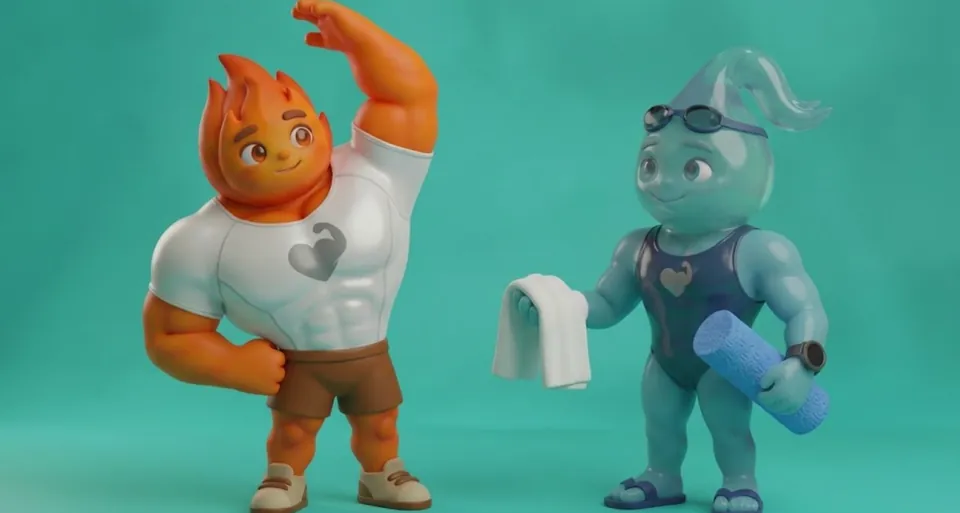
Emby: It's fine, I'll just push through it tomorrow too.
Dewy: Don't push through pain — ever. Soreness is just the dull ache that fades in a few days; pain is different, and it's your cue to stop.
Delayed onset muscle soreness is the tenderness and stiffness that turns up hours after exercise rather than during it. It's familiar to everyone from beginners to elite athletes, and it can range from mild tenderness to pain that's genuinely hard to move through [2].
It's especially common when you start training again after a break, or try a type of activity for the first time [2]. So if you're new, feeling it after your first few sessions is completely normal.
Why it happens
The honest answer is that nobody knows exactly. Researchers have put forward up to six different explanations, including muscle damage, inflammation and connective tissue damage, and the most likely answer is a mix of two or more of them [2].
A few things are clearer:
- The "lowering" part of a movement causes most of it. Eccentric movements, where a muscle lengthens while working (like lowering into a squat, or walking downhill), cause micro-injury to muscle more often and more severely than other kinds of muscle action [2]. According to Wikipedia's summary of the research, holding a position still (isometric work) leads to far less soreness, and the shortening, lifting phase (concentric work) doesn't cause it at all [1].
- It isn't lactic acid. The old idea that DOMS is lactic acid "stuck in the muscles" has been largely rejected. Lactic acid returns to normal levels within about an hour of exercise, and concentric exercise, which also produces it, doesn't cause DOMS [1].
- How hard and how long matter. The intensity and duration of exercise are both factors in how much soreness follows [2].
How long it lasts
DOMS typically builds over the first 24 hours, peaks somewhere between 24 and 72 hours after exercise, and then fades, disappearing within about seven days [1].
The good news: it gets easier
Here's my favourite bit. Doing a new movement once seems to protect you from as much soreness the next time. This is called the repeated bout effect: one session of lowering-heavy (eccentric) exercise leaves your muscles less damaged by the ones that follow [6]. Scientists are still working out exactly how, with theories covering changes in the nerves, the mechanics of the muscle and the muscle cells themselves [6].
The research summarised on Wikipedia describes this protection lasting at least several weeks [1]. It's one reason the later sessions of a new plan often hurt less than the first [6].
A 2003 review also suggested building up new activities, especially lowering-heavy ones, gradually over one to two weeks to limit the disruption DOMS can cause [2].
What helps, and what doesn't
This is where the research gets surprising.
| What | What the research found |
|---|---|
| Stretching | Tiny reductions in soreness |
| Gentle movement | Short-term relief only |
| Massage | Most effective of the methods compared |
| Foam rolling | A small reduction |
Stretching doesn't really reduce DOMS. A Cochrane review of 12 studies found that stretching before, after, or both before and after exercise did not produce meaningful reductions in muscle soreness in healthy adults [3]. The reductions it measured were tiny, around one point or less on a 100-point scale at one day after exercise [3].
That doesn't make stretching pointless. The NHS describes a short post-workout stretch as a way to cool down, relax, improve flexibility and let your heart rate come down gradually [7]. It just isn't a soreness cure.
Gentle movement gives short-term relief. A 2003 review found that exercise was the most effective way to ease DOMS pain, though the relief was temporary [2]. It also suggested easing off intensity and duration for a day or two after very sore-making sessions, or training less-affected body parts instead [2].
Massage came out on top in one big review. A 2018 meta-analysis of 99 studies compared recovery methods. Active recovery (light exercise), massage, compression garments, water immersion, contrast water therapy and cold therapy all reduced DOMS to some degree, and massage was the most effective for both soreness and tiredness [4].
Foam rolling helps a little. A 2019 meta-analysis found that foam rolling after exercise reduced how much muscle pain people felt, though the overall effects on recovery were small, and the authors thought the evidence better supported using it as a warm-up than as a recovery tool [5].
The easier version
Feeling stiff today? A gentle plan that fits what the research found:
- Move lightly. A walk or an easy bike ride, enough to feel a bit warmer [2][4].
- Train a different body part, or go easier. If your legs are sore, an upper-body day or a lighter session works [2].
- Do a short cool-down stretch if it feels nice. It won't erase soreness [3], but a gentle routine can help you relax and wind down [7].
Our post-workout stretch builder makes a short routine for whatever you trained, with an easier version of every stretch. Tension is fine, pain isn't. Try the stretch builder →
When it's not just DOMS
DOMS is an ache in the muscles you worked that fades over several days [1]. Some things are different and worth taking seriously. For a possible sprain or strain, the NHS suggests contacting NHS 111 if pain is very bad or getting worse, if swelling or bruising is large or growing, if you can barely walk or can't bear weight on it, or if it's not getting better after looking after it yourself [8]. It lists heading to A&E or calling 999 if you heard a crack, if the area has changed shape, or if it's numb, tingling or changing colour [8].
If in doubt, ask. Nobody at the NHS will think you're making a fuss.
Post-workout stretch builder
Pick what you worked, get a short routine that covers it — every stretch with an easier version.
Try it →Does being sore mean I had a good workout? Not necessarily. DOMS is mostly linked to new activities and to lowering-type movements [1][2], so it tends to fade as your body gets used to a routine [6], even when the training is working just as well.
Should I train when I'm sore? A 2003 review suggested lowering intensity and duration for a day or two after very sore-making exercise, or working less-affected muscles instead [2]. Gentle movement also gave temporary relief [2].
Will stretching before a workout stop me getting sore? The Cochrane review found that stretching before, after, or both made no meaningful difference to soreness in healthy adults [3].
Roll it out, go gently, and did you drink water today? I'm going to keep asking.
Checked against 8 sources · Updated 29 September 2026 · Expert review: not yet
kind.fit shares information, not medical advice. If something doesn't feel right, talk to your GP or call NHS 111.
- Wikipedia contributors. "Delayed onset muscle soreness." Wikipedia. https://en.wikipedia.org/wiki/Delayed_onset_muscle_soreness (accessed 29 September 2026)
- Cheung K, Hume P, Maxwell L. "Delayed onset muscle soreness: treatment strategies and performance factors." Sports Medicine, 2003;33(2):145–164. https://pubmed.ncbi.nlm.nih.gov/12617692/ (accessed 29 September 2026)
- Herbert RD, de Noronha M, Kamper SJ. "Stretching to prevent or reduce muscle soreness after exercise." Cochrane Database of Systematic Reviews, 2011;(7):CD004577. https://pubmed.ncbi.nlm.nih.gov/21735398/ (accessed 29 September 2026)
- Dupuy O, et al. "An Evidence-Based Approach for Choosing Post-exercise Recovery Techniques to Reduce Markers of Muscle Damage, Soreness, Fatigue, and Inflammation: A Systematic Review With Meta-Analysis." Frontiers in Physiology, 2018;9:403. https://pubmed.ncbi.nlm.nih.gov/29755363/ (accessed 29 September 2026)
- Wiewelhove T, et al. "A Meta-Analysis of the Effects of Foam Rolling on Performance and Recovery." Frontiers in Physiology, 2019;10:376. https://pubmed.ncbi.nlm.nih.gov/31024339/ (accessed 29 September 2026)
- McHugh MP. "Recent advances in the understanding of the repeated bout effect: the protective effect against muscle damage from a single bout of eccentric exercise." Scandinavian Journal of Medicine & Science in Sports, 2003;13(2):88–97. https://pubmed.ncbi.nlm.nih.gov/12641640/ (accessed 29 September 2026)
- NHS. "How to stretch after exercising." https://www.nhs.uk/live-well/exercise/how-to-stretch-after-exercising/ (accessed 29 September 2026)
- NHS. "Sprains and strains." https://www.nhs.uk/conditions/sprains-and-strains/ (accessed 29 September 2026)